
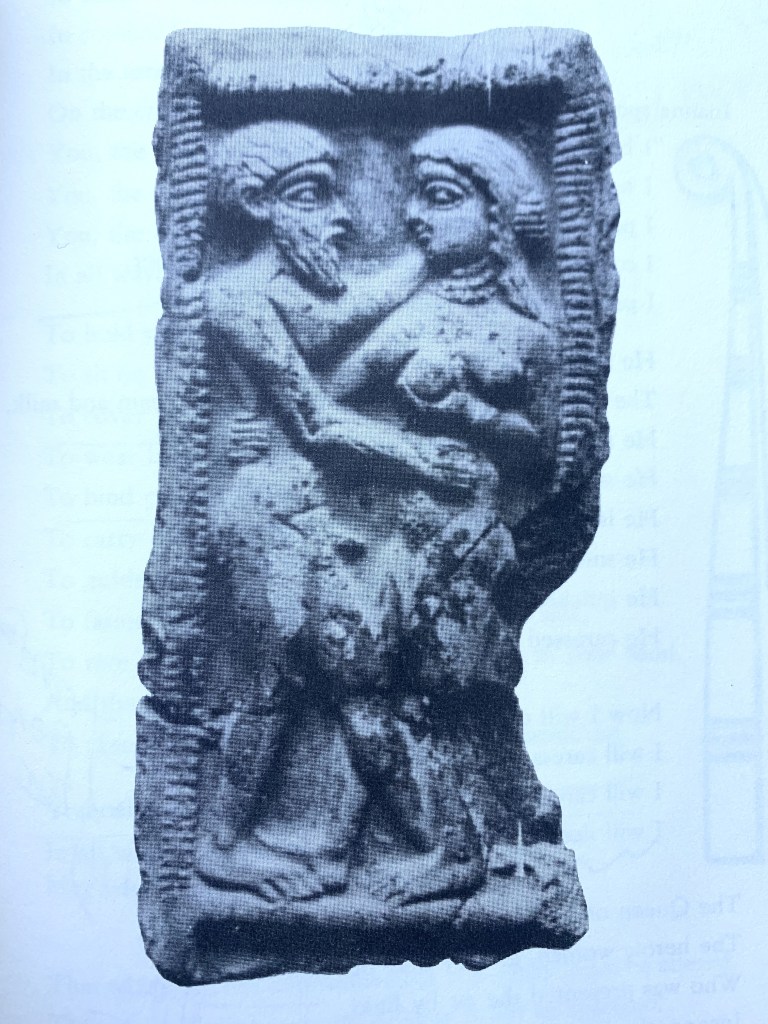
If you haven’t heard of the epic love story of Inanna and Dumuzi, that’s probably because it was written down sometime circa 2,000 BC, in ancient Sumer. (Sumer is the world’s earliest known civilization, and produced the first ever written texts and stories on clay tablets).
Inanna was a revered goddess, known as the Queen of Heaven and Earth. She literally ruled over everything. Dumuzi, on the other hand, was, in turns, a bull, a king, and in others still, he turned from a man into a bird.
(If you’ve read any of the True Born Trilogy, right about now you might be coming to a flashbulb moment on some of my influences as a writer.)
Regardless of what face Dumuzi wore, Inanna and Dumuzi get hitched. And let me tell you, theirs was a hot and heavy #Ship for the ages.
As Diane Wolkenstein writes, “The world’s first love story, two thousand years older than the Bible — tender, erotic, shocking, and compassionate — is more than momentary entertainment. It is a sacred story that has the intention of bringing its audience to a new spiritual place.” Inanna, Queen of Heaven and Earth (xix).
But, like so many of the greatest love stories, you can see threads of politics woven through their tale. In this passage, for example (translated by Wolkenstein), Inanna gets ready for her wedding night with Dumuzi. (Note: no one in ancient Sumer is shy to write about the saucy stuff):
She called for the bed that rejoices the heart.
She called for the bed that sweetens the loins.
She called for the bed of kingship.
She called for the bed of queenship.
“The Courtship of Inanna and Dumuzi,” Inanna, Queen of Heaven and Earth, 46.
“Kingship” and “queenship: are interesting terms. Not unlike young Romeo and Juliet, who represent their warring houses, Dumuzi and Inanna coming together in an act of love and marriage is one that is rife with political overtones.
This isn’t an accident. If my memory serves, Sumerian kings legitimized their rule through the cult of Inanna’s priestesses. In other words, to gain control of a kingdom, a king would need to ‘wed’ the goddess.
He would do so quite literally, by symbolically (and physically consummating) a marriage between the high priestess (acting as the living incarnation of the goddess) and the Sumerian king.
But while numerous political threads can be pulled in the Inanna and Dumuzi tales, in the end, it all boils down to love:
He put his hand in her hand.
he put his hand to her heart.
Sweet is the sleep of hand-to-hand.
Sweeter still the sleep of heart-to-heart.
The Courtship of Inanna and Dumuzi,” Inanna, Queen of Heaven and Earth, 43.
How influential was the love story between Inanna and Dumuzi? According to scholars, Inanna was later worshipped as the goddess Ishtar, and Dumuzi (or Dumuzid) became known as Tammuz.
Comparisons can also be drawn between the ancient Greek (and later Roman) story of Demeter, Persephone and Hades. The Inanna/Dumuzi tales include one in which Dumuzi is sent to the Underworld and, in a bid to bring her lover back, she brokers a deal by which Dumuzi can come back to live with her for half the year (bringing spring with him) and half the year back in the Underworld — coinciding with winter. Sound familiar?
And just how does the love story of Inanna and Dumuzi figure into the world of A Glamour of Blood? You’ll just have to read the book to find out! (Dropping August 28)
Images: Clay tablets, from: Inanna, Queen of Heaven and Earth: Her Stories and Hymns from Sumer. Diane Wolkensteing and Samuel Noah Kramer, Harper & Row, 1983. Art compiled by Elizabeth Williams-Forte.

 L. E. Sterling
Leave a comment